
You spend hours looking for leads, shaping your words and hitting send only to be greeted with dead silence. It’s frustrating, it’s draining, and it’s making a lot of people want to give up on outbound outreach altogether.
The question isn’t usually whether you’re a solo agency, independent contractor, or have a team providing remote VA staff in the Philippines, but how you get the message out.
Most outreach is like an automated infomercial, stiff, corporate, self-absorbed and obviously sent to a hundred other people randomly.
Stop doing it all. Delegate more.
Hire a vetted virtual assistant and get your week back — starting with a free discovery call.
If you want consistent replies, you have to stop pitching from pitch decks and start having simple, human conversations. An actionable step-by-step framework for reaching out to potential clients and actually getting a response.
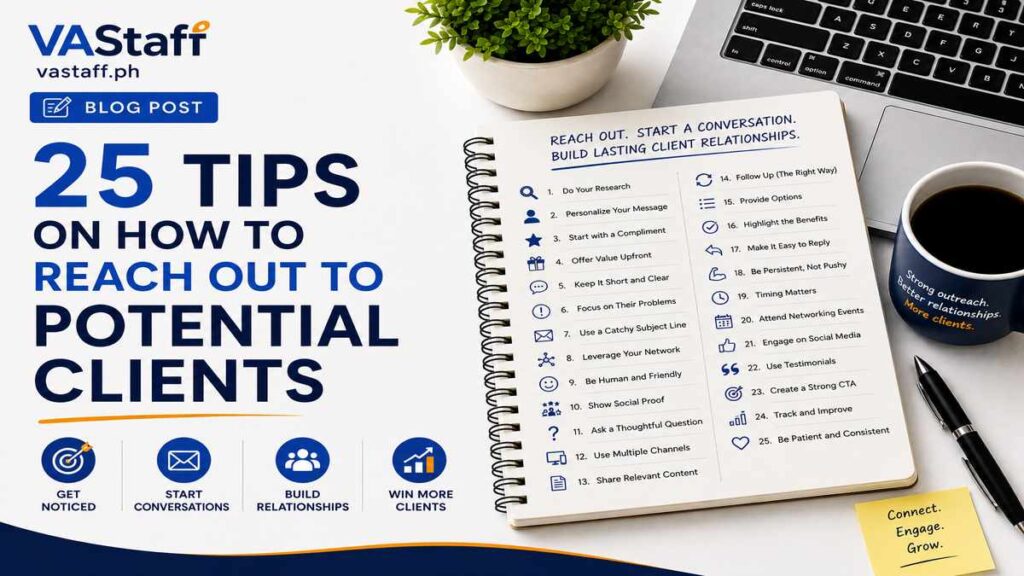
VA Staff will share 25 real-world, actionable tips on how to reach out to potential clients today.
1. Create a Focused Prospect List of 50 to 100 People
The wider the net you throw, the more you’re going to drown in low-quality leads that never buy. The first step to effective outreach is to narrow down your focus to a manageable, highly specific group of target companies.
- Define a tight ideal customer profile (ICP) before you begin searching. Company size, revenue, industry and the main operational headaches.
- Quality not quantity: Reaching out to 50 well-fitted companies will get you a lot more conversions than blasting emails to 1,000 random businesses.
- Batch your list building: Create a weekly block of time to find names and confirmed contact information so your outreach routine doesn’t get broken.
2. Know the Appropriate Decision Maker
A good pitch to the wrong person is a waste of time. Don’t send sales notes to generic inboxes like info@, support@ or generic contact forms.
- Company Websites and LinkedIn: Look at titles like Founder, CEO, VP of Operations or Head of Growth depending on who actually controls the purse strings for your solution.
- Check business directories: Clutch, ZoomInfo and local Chamber of Commerce rosters are good places to find key personnel.
- Identify the real decision maker: If you are providing executive support or specialized VA staff, speak to the executive who is overwhelmed by daily operations, not an entry-level employee.
3. Research each prospect for 5-10 minutes
Mass templates are DOA. Modern decision makers can tell a copy-paste template in two seconds. Dig for 5 to 10 minutes on a company and you have all the ammo you need to write a compelling personal message.
- Look at their public image: Scan their home page, recent blog posts, social media updates and news mentions.
- Know what they’re selling: Before you write a single word make sure you understand their main offer, intended audience and where they are going with their business.
- Find a personal twist: Look for mutual connections, a podcast they were on, or a recent accomplishment you can genuinely praise.
4. Find a Particular Business Issue
Don’t bombard them with a laundry list of services. People don’t buy ‘services.’ They buy solutions to immediate, frustrating problems.
- Identify a specific operational gap: Be on the lookout for broken checkout pages, slow website load times, customer reviews that are not answered, or slow response times on their customer channels.
- Focus on one issue: Pick the one biggest bottleneck that you can fix immediately.
- Tie it to business impact Wrap it around: Connect the problem to something that’s affecting their bottom line — lost revenue, wasted staff time, or missed leads.
5. Watch for trigger events
When a company is in transition, you’re getting a response rate that skyrockets. A trigger event provides a natural, immediate reason to pop into their inbox.
- Hiring sprees or expansions: When companies grow quickly, their operational systems often start breaking down under the pressure. This creates an urgent need for more support or remote VA staff.
- New Product Launches: Additional execution, design and marketing bandwidth will be needed for new product launches.
- Public complaints about customer service or slow delivery are negative reviews or old processes, and they are golden opportunities to show how you can fix their workflow.
6. Create a Custom Opening
Your first sentence is the thing that will get the rest of your message read or tossed in the trash. Avoid the normal robotic openings like “I wish you a pleasant day” or “My name is X and I work at Y.”
- Make it about them, not you. The first line should explicitly be about their company, a post they wrote recently, or a feature on their site.
- Proof of Work Completion: Begin with an opening that only they can write. If you are able to copy and paste your first line to another company, delete it and rewrite it.
7. Start with the Problem or Opportunity, Not Your Services
When first reaching out to you, no prospect cares about your business history, your awards, or your broad service menu. Their own goals and headaches matter to them.
- Immediately point out the gap: Let me know what problems or opportunities you have seen.
- Skip the credential dump. Save your bio and your deep technical resume for later in the conversation, when they ask for them.
8. Tell Us One Specific Way You Can Help:
State a Problem. Briefly state why you are qualified to state it, but do not beat around the bush.
- Quick micro case study: What other similar company did you help and what did you get out of it?
- Stay Real: We recently helped a similar e-commerce brand reduce their customer reply times from 4 hours to 15 minutes by plugging in dedicated VA staff in the Philippines.
9. The First Message should be 100-150 words
Long emails seem like a lot of effort. Busy decision makers often skim their inbox fast, usually on their phone between meetings.
- Respect their time. Be short, say what you want to say.
- Cut the fat. Cut the filler words, lengthy introductions and complex language. Make your note scannable and easy to digest in 30 seconds or less.
10. Don’t Sell a Call, Ask One Simple Question
To ask a busy stranger for a “30-minute discovery call” in your very first message is asking for too much, too soon. It causes unnecessary friction.
- Take the pressure off: And close your note with a low-friction question that takes no energy to respond to.
- Consider starting a conversation: Instead, ask for a simple “yes” or “tell me more,” not a full meeting right now.
11. Call to Action (CTA): Go Low-Pressure
Your call to action should be totally casual and risk free.
- First, check for interest: Try CTAs such as: “Are you facing this bottleneck today?” or “Open to seeing a quick 2-minute screen recording on how to fix this?”
- Be careful with sales pitches: Avoid pressuring language such as “When are you free for a call this week?” or “Let’s schedule a time to talk.”
12. Contact Via Multiple Channels
Cold email can only get you so far. You miss out on prospects who live inside other platforms. A multi-channel strategy ensures that your message actually gets seen.
- Touchpoint mix and match: Use cold email, LinkedIn connections, quick phone calls or social media interactions.
- Match their preferred platform: A tech founder may reply instantly on LinkedIn, whereas a traditional service owner might prefer a quick, direct phone call.
13. Develop a 5-7 Touch Follow-Up Sequence
The worst mistake you can make in cold outreach is to send one message and give up. Most of the deals that close happen because of polite, strategic follow-up.
- Spread your attempts: Spread your touchpoints out over 2 to 3 weeks so you remain present, but not annoying.
- Be patient: Remember that if they don’t reply it’s usually because they’re busy, not because they’re angry or not interested.
14. Change angle with every follow-up
Never use the old, followed-up, useless line: “Just bumping this to the top of your inbox.” With each message that you send, you should contribute something new.
- Share some new value every time: Drop a fresh insight, quick case study, helpful workflow template, or industry stat that’s relevant.
- Keep the dialog engaging: By changing your angle, you give your prospect many reasons to find value in your outreach.
15. Space Follow-Ups 2-3 Business Days Apart
It’s all about timing. If you send follow-ups every 24 hours, you look desperate and spammy. Waiting two weeks kills the momentum.
- Keep a healthy rhythm: Space your first few messages 2-3 business days apart, then space them further apart as the sequence continues.
- Respect business hours. Follow ups should be sent during your prospect’s business hours.
16. Call High-Value Prospects Directly
If a prospect represents a big potential deal for your business, don’t just rely on text-based outreach.
- Pick up the phone. A 60-second phone call, brief and polite, can bypass weeks of inbox clutter.
- Keep cold calls light: Talk about the particular problem you spotted and inquire if it’s something they’re trying to solve at the moment.
17. Send a brief personalized audit
If you see something blatantly wrong on a prospect’s site or marketing channels, show them the fix before you ever ask for a contract.
- Make a short loom video: Record a 2 minute screen share showing the problem and how to solve it.
- Provide real value up front: Instant credibility and trust are established by undeniable evidence of your knowledge.
18. Use social proof wisely
Claims are nothing without proof. Support your promises with real-world examples such as your prospect’s reality.
- References contextual: Share results, short testimonials or metrics from businesses in their industry.
- Make numbers realistic: Practical results (e.g., “saved 10 hours a week on admin”) seem much more credible than outrageous claims.
19. Track every lead in a spreadsheet or CRM
What you don’t measure, you can’t manage. Trying to remember dozens of prospects in your head will cause you to lose conversations and deals.
- Record Key Data Points: Track contact dates, response status, notes on pain points, scheduled follow up dates
- Keep your pipeline clean , update your records daily to know who you need to respond to and who you need to push out to a later touchpoint.
20. Prioritize Buying-Interested Prospects
Some leads are better than others. Instead, use your immediate energy to focus on prospects that are showing interest.
- Look for signs of intent: People clicking on your links, looking at your LinkedIn profile, opening your email more than once, asking you specific questions.
- Strike while the iron is hot: Act fast when a lead shows activity – hot prospects turn cold quickly if not nurtured.
21. Respond promptly to interested prospects
If a prospect says they’re interested, your speed to respond is your single biggest competitive advantage.
- Reduce lag respond to warm leads within an hour if possible while your message and problem are still fresh in their mind.
- Keep the momentum: while they are busy and active at their desk, strike them to easily lock in the next step.
22. Qualify Your Leads Before You Invest Sales Time
Not every interested answer is a good fit. Qualify prospects upfront and save yourself hours of wasted discovery calls.
- Review the main criteria: Ensure they have the right budget, the authority to make decisions, a real need, and a realistic time frame.
- And please weed out the bad fits: If the prospect is too small or has a small budget for your services/remote VA team, politely redirect them before you spend hours on custom proposals.
23. Don’t Chase Prospects Forever
Knowing when to back off is just as important as knowing when to follow up. You’ll waste time chasing leads that never answer and clog up your pipeline.
- Send a nice ‘break-up’ email: Send a final, low-key message, after 5 or 7 tries, letting them know you will step back for now.
- Put cold leads on a long-term list Instead of spending time on active cold outreach, put unresponsive prospects on a quarterly check-in sequence or newsletter roster.
24. Check Your Numbers Weekly
Outreach is a system that requires constant tuning. Monitor your conversion rates at each step of your sales funnel so you can see where your leads are falling thru the cracks. Notice the important people:
- Track: Outlook → Reply → Positive Feedback → Contacted → Proposals Sent → Meetings Booked → Clients Won
- Identify bottlenecks If your open rate is high but your reply rate is zero, then your message is the problem. If replies are high but meetings are low, you need to work on your offer or CTA.
25. Fortify the Weakest Link in Your Funnel
Don’t fall back on simply “sending more outreach” when results slow down. More emails thru a broken process just wastes good leads faster.
- Optimize step by step: find exactly where prospects are dropping off, and fix that one thing first.
- Keep refining. Tweak subject lines. Adjust messaging angles. Tighten target list. Until the pipeline flows smoothly start to finish.
Summary
Effective outreach ultimately boils down to treating prospects like real human beings dealing with real business issues. When you stop using the generic sales scripts, focus on a narrower audience, lead with real value, and have a consistent follow-up process, cold outreach stops feeling like a chore and becomes a reliable, predictable engine for long-term business growth.
Frequently Asked Questions
1. How long should I actually wait before sending a follow-up?
Give it 2 to 3 business days before your first check-in. Inboxes fill up fast, and people get sidetracked—3 days gives them space to breathe without letting your first note go completely cold. If you still don’t hear back, space out your next notes even further (like 4 or 5 days apart). You want to stay on their radar, not crowd their inbox.
2. Is cold calling actually dead, or should I still try it?
It’s definitely not dead—it’s just misunderstood. While email and LinkedIn are great for everyday outreach, a quick, polite 60-second phone call can save you weeks of playing inbox tag. You don’t have to call everyone, but if a lead represents a huge deal for your business, picking up the phone is often the fastest way to get a straight answer.
3. How can I tell if someone is just busy vs. completely uninterested?
Look for subtle trail marks. A prospect who is just busy will often open your email a few times, click your links, or check out your LinkedIn profile—even if they haven’t typed a reply yet. Someone who isn’t interested will usually hit you with a quick “no thanks,” unsubscribe, or ignore 5+ messages completely. If you see signs they’re looking, stay patient and keep dropping helpful bits of value.
4. How does having VA staff in the Philippines help with outreach?
The hardest part of cold outreach isn’t the actual chatting—it’s the repetitive prep work. A Filipino VA can do the heavy lifting: build prospect lists, chase down direct emails, research trigger events, and keep your CRM clean. That way, you or your sales leads are only brought in when it’s time to have real conversations and close deals.
5 . What kind of response rates should I realistically expect?
When you’re doing tight, highly personalized outreach (sticking to that 50–100 prospect list), aiming for a 10% to 25% reply rate is a solid baseline, with roughly 5% to 10% turning into actual calls or booked meetings. If you’re getting under 5%, don’t panic—it usually just means one part of your chain needs a tweak, like shortening your message or targeting a better decision-maker.
What's your business?
Company name and what you do — a line is plenty.
How many VAs do you need?
A rough number is fine — you can scale later.
What do you need help with?
Pick a category — you'll choose specific roles next.
Which roles do you need?
Pick any that apply — or add your own below.
How many hours per month?
Full-time or part-time — pick what fits.
Where do we send your matches?
We'll email you a shortlist of VA candidates.
You're all set!
We'll review your answers and send a list of matched VA candidates to your inbox — usually within one business day.
Or book a free call now →