
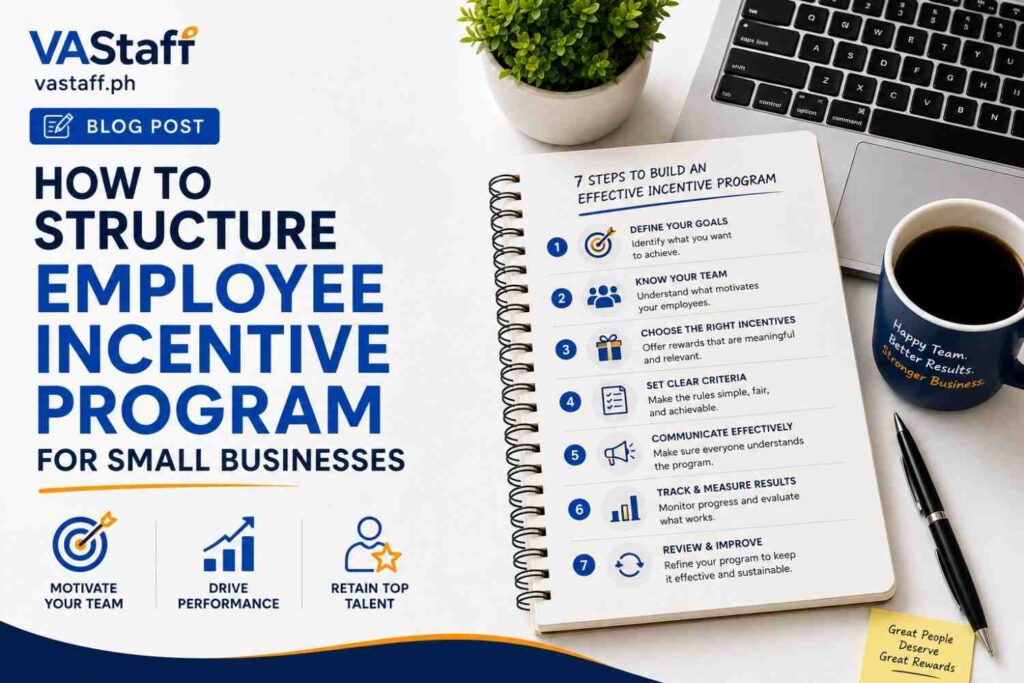
One of the biggest challenges for any entrepreneur today is keeping a team motivated. This is one of the secrets to achieving high productivity within companies. There are several strategies that can help in this regard, and one of them is implementing employee incentive programs.
In addition to retaining and developing talent, these programs generate many advantages for your company. They can be implemented in any type of organization, including small businesses and those that are just starting out.
If you own a small business and need to increase your team’s productivity and retain good professionals, VA Staff, a virtual assistant agency in the Philippines will help you structure employee incentive program for small businesses.
Stop doing it all. Delegate more.
Hire a vetted virtual assistant and get your week back — starting with a free discovery call.
Read this post and understand everything you need to know about incentive programs, their benefits, and how to structure them in your company.
What is an incentive program?
An incentive program can be understood as a system of goals and rewards, whose objective is to recognize, stimulate, and reward the behavior, engagement, and performance of employees and work teams.
In other words, it’s a way to encourage employees, as well as teams, to strive for a high level of performance, based on goals and rewards.
These practices benefit employees, who feel more motivated, and also companies, as they increase productivity, improve performance, reduce turnover, among other benefits that will be explained later.
Many successful entrepreneurs are already using this system, instead of simply granting salary increases, thus objectively rewarding the performance and professional growth of their employees. An organization can provide both financial and non-financial incentives.
In the first case, the employee receives cash bonuses. In the second, they receive trips, time off, outings, prizes, among many other forms of rewards.
Who is entitled to the employee incentive program:
Basically all employees, such as:
- Executive Level
- Administrative Level
- And even Human Resources.
These awards should be linked to some number, such as:
- Sales volume;
- Customer prospecting rate;
- Average revenue;
- Cost reduction target;
- Meeting deadlines, among other things.
Those who wish to develop a team with diverse skills should also link rewards to courses, specializations, postgraduate studies, and other forms of professional development.
For an incentive program to yield positive results, it requires a joint effort between leaders and employees. Furthermore, it is necessary to establish clear communication, define achievable goals, keep promises on time, and have engaged leadership.
What are the three pillars of the incentive program?
The incentive program is based on three pillars: motivation, recognition, and reward. Let’s explain each of these pillars.
Motivation
Using incentive campaigns has a direct impact on the motivation of employees and teams. It’s a way to attract and retain talent, as well as to build and maintain high-performing teams.
Therefore, before defining goals and rewards, it is essential to understand the aspirations and objectives of the employees. Only then can you define more targeted rewards, making them feel engaged and collaborative, since they will achieve what they want through their own effort.
Recognition
The second pillar of the incentive program tripod is recognition. It is based on the premise that employees’ efforts should be recognized and valued.
Therefore, professionals who dedicate themselves more will have a greater return. This is also a way to assess the potential of each employee and place them in the right positions, and even higher ones.
Reward
The final element of the tripod is reward. This refers to compensating workers for their efforts according to their dedication and performance.
This element demonstrates that the incentive program is based on meritocracy, transparency, and impartiality, since each person receives the reward directly in relation to their level of performance.
The message conveyed is that the company is committed to treating all employees fairly, as each individual’s effort and performance are evaluated.
Therefore, career growth and advancement are the responsibility of the employee, not personal relationships or friendships with superiors, as is seen in many organizations.
Are incentive programs only for large companies?
The answer is no. As you will understand, it is simple to structure an incentive program in any type of organization.
Incentive programs are an ideal way for those seeking to increase productivity and keep teams motivated, regardless of the company’s size or sector.
Once the entrepreneur recognizes the importance of investing in human capital and understands how much benefit this can bring to their company, they can begin planning an incentive program.
What are the benefits of implementing an incentive program?
For the company, the benefits of implementing an incentive program go far beyond keeping a team motivated. Considering the company’s operational activities and human capital, the benefits program:
- It increases productivity;
- increases revenue;
- reduces costs and expenses;
- It optimizes operational and administrative routines;
- It reduces turnover and absenteeism;
- retains talent;
- It improves the organizational climate;
- It conveys a good image of the company;
- It attracts new talent.
These benefits can be understood in a chain-linked manner.
Once the company sets the goals, employees must meet them to receive the rewards. Since it’s a merit-based system, this employee will want to give their best, which will consequently increase productivity and reduce costs for the company.
Ultimately, the greater the production, the more diluted the costs become. An employee who is engaged in the incentive program will not want to miss work for any reason, since their reward will be proportional to their dedication.
What can a performance-based incentive program lead to?
Typically, setting individual goals leads to healthy competition among employees. Therefore, the employee will do everything in their power to be at work every day, focused on meeting the goals.
If the reward system aligns with the employee’s aspirations, they will also not want to leave the company, as it meets the company’s expectations.
This reduces the turnover that entrepreneurs dread, as it generates high costs. A satisfied employee will tell others about the company’s internal environment, which can attract new talent.
It’s also worth mentioning that it’s more economical to retain and develop your existing team than to form a new one. Each employee who leaves represents a loss of money due to severance pay, the recruitment process for a new employee, and training.
The organizational climate also improves, as people understand that the program will have better results the better the cooperation between teams. Ultimately, all work is collaborative, and even when there is some competition, no one can achieve results in isolation.
Furthermore, keeping employees motivated greatly contributes to developing a positive company image among customers, suppliers, and employees. Attracting new talent becomes easier as your company gains recognition as a great place to work.
What should I know before planning an incentive program?
Let’s explain a few details you should be aware of before you start planning your incentive program. The first is to try to understand the employees’ needs and desires.
Understand what motivates your employee.
To avoid common mistakes in small businesses and ensure the program yields positive results, it’s important to conduct a survey to understand which types of benefits will be most suitable for employees’ objectives.
This way, you can establish rewards that are consistent with the profile and the stage of life these people are in. To help you understand what we’re saying, let’s give two different examples.
In the first scenario, imagine that your company consists mostly of younger people, students, and university students. They tend to be more interested in certain benefits, such as language courses, scholarships, gym discounts, and travel.
But if most of the team already has families, they tend to prioritize time off, health insurance, and meal vouchers , or a weekend at a country hotel with their family.
These differences should be considered when establishing rewards that will truly motivate people to contribute to your business goals.
Find out which benefits are mandatory and which are optional.
Before deciding on the benefits that will be offered in this program, it is important to know that some benefits are mandatory and others are optional. Therefore, if your company uses the CLT (formal employment contract) system, it is necessary to understand the rules in order to avoid incorrectly linking benefits to the program.
First of all, it’s important to remember that paying benefits in cash entails higher costs and may lead to labor lawsuits in the future. Therefore, it is always better and more profitable to take advantage of benefits, whether they are mandatory or optional.
Mandatory benefits such as:
- Transportation voucher ;
- Paid vacation;
- Thirteenth salary;
- Night shift allowance;
- Childcare assistance is only mandatory for companies with more than 30 employees. In smaller companies, it becomes optional.
As optional benefits, we have benefit cards, such as:
- Food voucher;
- Meal voucher;
- Medical assistance;
- Dental care;
- Cultural voucher;
- Gift certificate;
- Scholarship;
- Language courses;
- Discounts on courses, among other things.
It’s important to remember that you can define which benefits will be offered to employees, but you cannot remove those that are mandatory. What you can do is increase the number of vacation days by granting time off, for example.
But when it comes to benefits programs, it’s more advantageous to combine optional benefits, always keeping in mind the company’s financial situation.
Always communicate goals, results, and rewards.
Clear communication is one of the most important elements for the effectiveness of an incentive program. To ensure all employees understand the rules and how this program will work, it is essential to use different forms of communication.
Furthermore, to keep people engaged over time, it’s necessary to communicate updates on goals and the results achieved.
To ensure communication reaches everyone involved without any misunderstandings, you should utilize the various communication tools available in your company, such as email, intranet, corporate social networks, bulletin boards, regular team meetings, and others.
The better the communication, the more efficient the results will be.
Knowing these peculiarities, you can use and abuse your creativity when offering benefits to your employees.
But don’t forget that you should consider the company’s objective and the employees’ objectives, so that the program is as aligned as possible with these two aspects.
How to structure an incentive program?
To structure an incentive program, it’s essential to pay attention to several aspects, such as individual and collective goals, rewards, and feedback. Let’s explain each of them.
1. Define individual and collective goals.
It’s necessary to define the company’s objectives and goals , and then define the objectives related to the incentive program. Both must be aligned. In this way, a program is used to motivate employees to generate the results that their company needs. Individual goals foster self-confidence, discipline, commitment, and the personal and professional development of each employee.
They should be ambitious, but at the same time realistic and tailored to the employee’s role and experience. Collective goals are very important for fostering a pleasant organizational climate and encouraging integration and collaboration among teams.
These individual and collective goals are complementary and promote the gradual and constant development of a company’s human capital. The indicators used to measure the goals need to be clear and intelligent, facilitating the supervision of tasks.
2. Determine the rewards.
Once the goals are defined, the rewards must be determined. This should be done before announcing the program to employees. They need to be aware of how each of their efforts will be rewarded.
As we’ve discussed before, the definition of rewards should be linked to a prior survey among employees to understand which benefits they value most.
In addition to understanding employee characteristics such as age range, education level, marital status, average salary, hobbies, and other factors, it’s important to look for successful examples in other organizations and understand the trends and best practices related to rewards.
Going through this research phase and combining these variables will make your awards portfolio more attractive. Many companies have invested in reward programs that provide experiences for their employees.
Examples of rewards
Travel, tickets to shows, movies, theaters, and the culture voucher are examples that provide positive experiences Other rewards, such as electronic devices, may be simple, but they have been chosen as a way to constantly remind the employee of the recognition received, since they become part of the recipient’s daily life.
Furthermore, the relationship between goal and reward must be clear to everyone involved. Goals cannot be unattainable. This would ruin all the planning and risk demotivating the team. And the rewards must be able to be fulfilled within the deadline, so that the program does not lose its validity and reliability. When defining rewards, care must be taken not to exceed one’s means.
Therefore, it is beneficial to link the amount spent on rewards to the magnitude of the productivity increase . This way, the program will not represent new investments that exceed its profits. For beginners, it is recommended to opt for simpler bonuses and smaller prizes, gradually increasing them as the program develops and the results it generates are measured.
Many companies resort to one-off rewards, such as trips, themed outings, gifts, event tickets, and more.
The reason for choosing these alternatives is that they eliminate labor costs, and the employee can have new experiences provided by the company, often involving the family, which further strengthens the bond between the worker and the organization.
4. Invite employees to participate in the planning process.
A very interesting strategy for planning an incentive program is to involve the team in defining goals and rewards. In this way, the employee will have the opportunity to participate in certain company decisions and will feel valued.
Furthermore, this participatory format minimizes the mistakes that companies commonly make, such as setting unattainable goals and rewards that are not attractive to internal audiences.
Furthermore, employees are the ones who possess the greatest knowledge about routine tasks and what needs to be improved to achieve the company’s goals.
5. Provide the necessary resources.
Once the program has been properly planned and the goals have been defined, it is important to verify that all the resources needed for the activities are available and in perfect condition.
There is nothing more demotivating than having to use outdated tools that hinder tasks, preventing employees from performing their work in the best possible way.
This concern, therefore, should be the company’s responsibility. It is up to them to provide the resources so that their employees can deliver the services expected of them.
6. Give feedback constantly.
There’s no point in planning a well-structured incentive program if, after publicizing it, you don’t have the proper follow-up and necessary feedback. The more efficient the feedback system, the better the individual and team results will be. Sometimes, a person needs to know which area requires improvement.
And this starts with good communication between managers and employees. The smaller the company, the closer this dialogue should be. This way, the faster the employee will have the chance to improve their performance.
This feedback should be both positive and negative.
An employee’s actions that demonstrate engagement, dedication, and proactivity should be monitored and praised, preferably in real time and publicly. Similarly, mistakes should be corrected, preferably in private, to avoid embarrassment within the team. The leader’s role is essential for the effectiveness of feedback. They must be both cordial and professional.
Furthermore, he should give the employee space to express their opinions and offer suggestions, thus establishing a relationship of trust and co-participation. When giving feedback, it is recommended to encourage the employee to do so in the following month, so that they see each piece of feedback as an opportunity to improve.
Therefore, it is always important to balance pointing out areas for improvement with praising the professional’s performance.
7. Utilize satisfaction and organizational climate surveys.
Conducting satisfaction and organizational climate surveys is also a way to verify the acceptance of the program among employees, and thus check the improvements perceived by the teams. This way, you’ll have the opportunity to improve the program for the next period.
8. Celebrate the results of your incentive program.
Nothing is more unifying than celebrating victories together with the team. Organizing celebrations at the end of each month, with photos of those who had the highest performance, documenting the awarding of rewards, is an interesting way to show that the program is truly effective.
This also communicates to the employee that it is worthwhile to put in more effort in the next period.
9. Study an incentive program that serves as an example of success.
Many companies, both in Brazil and abroad, have already realized the potential of a well-structured incentive program and have obtained excellent results.
Studying successful initiatives helps to better define the ideal program for your company’s reality and objectives. In other words: delve into benchmarking and achieve the best results!
Why always offer more benefits to employees?
From this reading, you have a better understanding of how an incentive program can bring various benefits to your business, regardless of its size. It doesn’t matter if your company is large, medium, or small. It doesn’t matter if it’s already established or just starting operations.
An incentive program improves employees’ quality of life and engagement with your business goals. This leads to increased productivity, higher sales, and greater profits.
Therefore, it’s important to always pay attention to your employees and see how they are reacting to goals and rewards, and always offer them the best benefits package.
This way, you can offer more and more opportunities to those who are with you on your company’s journey.
Now that you understand everything you need to know about incentive programs, you’re ready to start implementing these tips in your company and reap all the benefits of this strategy.
After learning more about incentive programs, offer VR benefits to your employees at no cost!
What's your business?
Company name and what you do — a line is plenty.
How many VAs do you need?
A rough number is fine — you can scale later.
What do you need help with?
Pick a category — you'll choose specific roles next.
Which roles do you need?
Pick any that apply — or add your own below.
How many hours per month?
Full-time or part-time — pick what fits.
Where do we send your matches?
We'll email you a shortlist of VA candidates.
You're all set!
We'll review your answers and send a list of matched VA candidates to your inbox — usually within one business day.
Or book a free call now →