
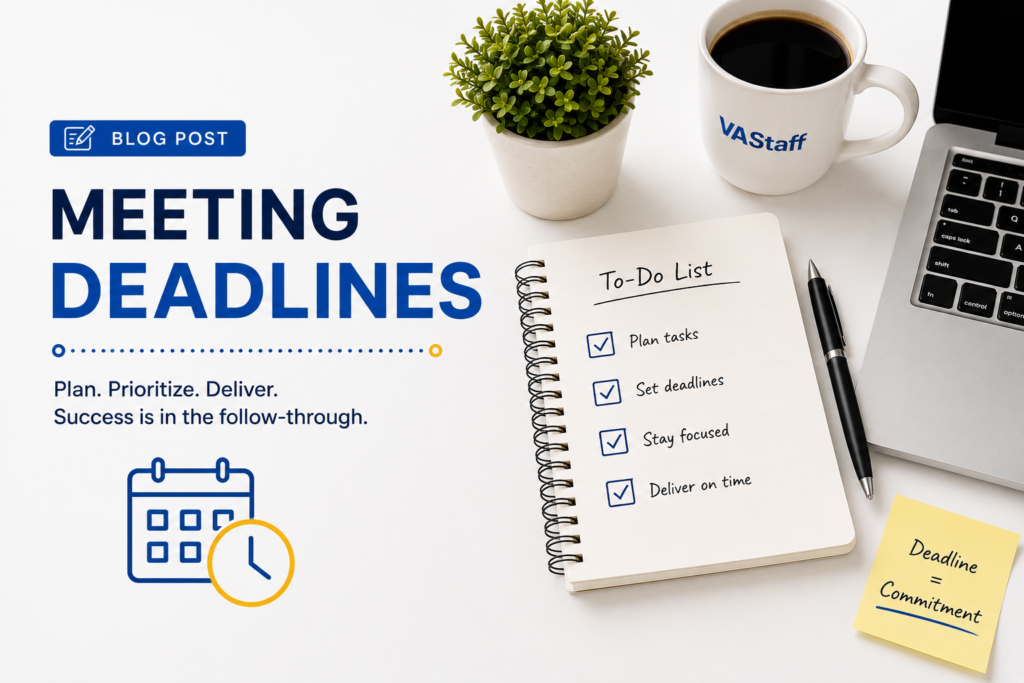
We’ve all been there. It’s 4:45 PM on a Friday, your heart is pounding, you’re staring at a blinking cursor, and a huge project is due in fifteen minutes. You’ve worked all week long, non-stop, and for some reason the clock got the best of you. It’s frustrating. It’s exhausting. It’s so unnecessary.
In the workplace today, there is a big difference between being busy and really getting things done on time. When you’re busy, your day is full of emails, back-to-back meetings and rapid-fire drills. When you finish work on time, you are consciously moving projects across the finish line without the last minute panic.
Meeting deadlines is important because it directly impacts your team’s productivity, customer satisfaction and the professional trust you build with colleagues and clients. If you always deliver on your promises, people know they can count on you. But missed deadlines, stress rises, trust diminishes, and team processes grind to a halt.
Stop doing it all. Delegate more.
Hire a vetted virtual assistant and get your week back — starting with a free discovery call.
So why do smart, hard working people miss deadlines? Usually it’s a few common pitfalls, like taking on too much at once, not realizing how long things actually take, or waiting for feedback from someone else without following up.
Here at VA Staff we see first hand how structured systems remove chaos from work days and create a smooth and predictable flow. You don’t need to work 14-hour days and drink endless cups of coffee to stay on time. It comes down to a practical, repeatable system. Here are the exact actions you can take to take control of your calendar and deliver quality work every single time.
Know the Deadline Well
Before writing a single sentence, designing a single slide or opening a spreadsheet, you need to stop and get absolute clarity on what you are being asked to do. The majority of missed deadlines simply stem from the fact that the person assigned has no real grasp of the scope or the required timeframe.
So, when you get a project, make sure you check every single requirement upfront. You need to know exactly what needs to be done: whether it’s a rough outline or a finished final draft. You need to know the exact due date, exact time and proper time zone as 5:00 PM Eastern is a big difference from 5:00 PM Pacific. It is also useful to understand who has the ultimate responsibility, what “complete” actually means and who needs to review or approve the work before it is officially considered finished.
Your rule of thumb here is simple. Don’t end a meeting, conference call or email thread without a specific deadline or deliverable. If your boss says, “Please get this done ASAP,” respond politely and offer two specific time slots to choose from. Working out these little details in advance can save you hours of wasted effort down the road.
Break Big Projects into Small Tasks
Big assignments can be daunting when the final deadline appears so far away. When a project lands on your desk with a month to go, human nature tells you you have loads of time. Then you wait until week three and all of a sudden you’re in crunch mode.
The best way to fight back is to break every huge assignment into smaller, bite-sized stages. A typical project usually involves initial research and planning, followed by drafting, reviewing, revising, and the final submission.
If you don’t want to set a single deadline for the final submission, then set a specific deadline for each major step along the way. If your final project is due in three weeks, aim to complete your research by day three and have a first draft by week two. When you convert a huge mountain into a series of small, easy-to-manage hills, the momentum takes care of the forward motion for you.
Organize Tasks by Urgency and Importance
Not all the tasks on your to-do list deserve equal amounts of your time and energies. Treating every email and little task like it’s an emergency means the most important projects will inevitably slip.
Use a simple four-tier priority system to stay on top of your workload. P1 activities are work that is critical, urgent, and there is a hard deadline. They are for now. P2 tasks are important but not urgent. These include strategic planning and long-term projects that create real value before they become emergencies. P3 tasks are daily routine operations and quick admin tasks. P4 tasks are low impact activities that can be delegated or even skipped altogether.
Energy management is about prioritizing your energy to the work with the nearest deadline. Eliminating quick, low-priority tasks can be satisfying, but it won’t help you when a major project is due at the end of the day.
Estimate the Actual Time the Work Will Take
One of the quickest routes to falling behind is to underestimate the time it will take to do a job. Often we plan for the best case scenario. Our computer will run fast, no one will interrupt us, and the first attempt will be perfect. But life doesn’t always go the way you want it to.
Don’t forget to include the whole range of your workday when you’re figuring your time estimates. That involves actual hands-on time, deep research time, internal review cycles, waiting for responses, scheduled meetings, and unforeseen technical glitches.
If you think something is going to take three solid hours of work, take a good look at your calendar. Do you have 3 hours free today with no interruptions or do you have four meetings and a lunch break? For complex tasks, always double your initial mental estimate to allow for the everyday friction.
Set an Internal Deadline
One of the smartest habits you can build is to detach your personal completion date from the official finish line. If your client or manager wants a report by 5:00 PM Friday, that is not the deadline you should be aiming for.
Instead, make a reverse schedule for yourself. Set your last review for Wednesday afternoon, set your personal internal deadline for Thursday noon and keep the Friday client deadline as the final destination.
Having an internal target allows you a nice little buffer for the unknown. If your internet crashes, a client asks for a last-minute change, or your morning gets hijacked by an emergency meeting, your project will still hit the stakeholder right on time.
Begin Significant Projects Early
It’s easy to wait for the moment you’re fully inspired or your whole afternoon is free to tackle big projects. But waiting until you’re near the deadline puts a lot of pressure on you and leaves no margin for error.
If a project is going to take more than a day or two, get started on it right away. You don’t have to do half the project on day one. Just open the document and write the outline or put together the file folders. That first milestone is also that first barrier in the mind to getting started. More importantly, jumping in early allows you to identify missing information, broken links or logic gaps while you have plenty of time to correct them.
Cut Out the Distractions
Subtle attention-grabbers are everyplace in modern workplaces; they quietly steal away your productive hours. You glance at a quick notification, reply to a chat message, scroll social media for five minutes and poof, an hour of peak focus is gone.
Social media feeds, long or unproductive meetings, incessant pinging from team messaging apps, personal phone calls, checking your inbox every 10 minutes, or jumping from project to project all quickly throw people off schedule.
Block off periods of deep work on your daily calendar to maintain your focus. Close your email tab, put your phone in a different room or on silent and set your status to do-not-disturb in these blocks. You’d be surprised at how much faster you’ll get through complex tasks when your brain isn’t constantly shifting gears.
Don’t Multitask
To many, multitasking is a badge of honor, but research consistently shows that trying to perform multiple complex tasks at the same time slows you down and makes you more prone to errors. When you switch from writing an article to answering a chat to tweaking a graphic, your brain is wasting energy reorienting itself every time you switch.
Practice doing one thing at a time, rather than everything at once. Pick one single, high-priority item and work on that item only for a set block of time – say, forty-five or sixty minutes. Complete the task or a major logical stopping point, then take a short break and move on to the next item. Work done on one thing with full attention is of a much higher quality and done in a fraction of the time.
Use a Task Management System
Don’t ask your memory to remember due dates, requests for feedback and action items. That’s a recipe for missed deadlines. Your brain is for coming up with ideas and solving problems, not for storing dates and sticky notes.
Make it a habit to use a digital platform such as Asana, ClickUp, Trello, Monday, Notion, Google Tasks or Microsoft Planner to stay organized. Whatever platform your team prefers, make sure every entry clearly states the assigned owner, final deadline, priority level, current status, and immediate next action. Once your system is up to date, you can look at your dashboard and immediately see what your system is up to.
Monitor Your Progress
A project timeline is a great place to begin, but you also need to keep track of your movement through it. Don’t wait until the last due date to see if you’re on track.
Standardize your work classification with standard progress stages so that everything moves steadily from not started to in progress, under review and done. For multi-week initiatives, schedule a quick five-minute self-check at the start or end of each day to confirm you are where you expected to be. If you find you are falling behind on step two you can adjust your schedule immediately instead of scrambling to correct step five at the last minute.
Identify Dependencies Early
More often than not, missed deadlines are not because you haven’t tried, but because you’re waiting on someone else to do something. These roadblocks are called dependencies and they surprise teams all the time.
Typical dependencies include waiting for a client to bless a concept, waiting for a colleague to send important data, waiting for custom assets from a creative team, waiting for a manager’s sign off or waiting for IT to provide software access. Identify these dependencies right from the start when you map out a project timeline. Get in touch with the people you depend on as soon as possible, give them precise dates for when you need their input, and follow up politely before a delay jeopardizes your final deliverable.
Address Problems Up Front
One of the worst habits you can build in a work setting is to wait until the hour a project is due to reveal a delay. If you find out on Tuesday afternoon you can’t meet a Friday morning deadline, say so Tuesday afternoon.
If you can see a delay coming, reach out to your manager or client with an honest status update of what you are waiting on, when you expect to get it and how that impacts the final delivery date. Raising flags early allows your team time to adjust expectations, reassign resources or help you clear obstacles. People value honesty and proactive communication so much higher than excuses at the last minute.
Communicate Your Expectations
Check that the date is realistic, given what you are already working on, before you commit to a deadline. Then you say yes to an impossible schedule just to sound eager or helpful – and almost always end up disappointed later.
When you accept a new assignment, first confirm the scope of work, expected deliverables, relative priority to your existing tasks, available resources, key dependencies and the target due date. If a requested timeline is just not doable, say so immediately and offer a realistic alternative, like a condensed summary on the original date or the full project a few days later.
Implement the 80% Rule of Progress
Trying to be perfectly complete on your first pass can slow you down. You spend hours perfecting the intro paragraph and the rest of the project just sits.
Instead, take the 80% rule and try to get a complete, working first version out as soon as is reasonably possible. Now that you’ve got a working base, look at the draft and see if there are any big gaps, get some early feedback from a manager or colleague, improve the work based on their real input, and finish off the final details. Getting a solid draft done early takes away the fear of the blank page and gives you plenty of time to polish the work without stressing about the clock.
Add a Buffer to Your Schedule
If you schedule each and every minute of your workday back to back, one fifteen minute delay will throw off your entire week. Unpredictable things happen all the time, so your schedule should have room to absorb shock.
Ensure that you leave deliberate open time in your weekly calendar for the inevitable last-minute high priority requests from leadership, unexpected technical issues, unplanned revisions based on client feedback, or overflow time for assignments that take longer than anticipated. A zero-buffer deadline schedule is not an optimal plan, it is a gamble. Extra breathing room built in keeps your day calm when life happens.
Check Work Before Sending
However, delivering a project on time doesn’t mean anything if the final product is full of sloppy, avoidable mistakes. Being late hurts your reputation, and hitting send without looking over your work after rushing across the finish line hurts too.
Schedule a final quality review in 5 minutes before you submit any work. Re-read the original request to ensure all requirements have been met, double-check key numbers and dates, run a spellcheck, check that all attachments are included, test any web links, and confirm formatting consistency. A few minutes spent on a final quality check ensures that when you’re on time, you’re also excellent.
Use a Daily Deadline System
Good workflow management is not a monthly habit. It’s a daily habit. A little routine at the start and end of each workday helps keep you grounded and focused.
Take a look at your main task list at the start of the day to note your top three must-do priorities and check any external dependencies. During focused time blocks during the day, work on those priority tasks and update your status as you accomplish steps. Log your accomplishments at the end of the day, review tomorrow’s schedule and sensibly reschedule any unfinished tasks so that nothing falls through the cracks.
Add a Weekly Deadline Review
As well as your daily habits, take fifteen minutes, every Friday afternoon, to think about the whole of your week. You can spot bad habits before they compound with a bird’s eye view.
Ask yourself what projects you completed on time, what deliverables were late, and why certain steps took longer than anticipated. Check what deadlines are coming up next week so you can get ready now and see if there are any routine admin tasks you can hand over. Transforming weekly deadline management from a stressful, reactive chore into a skill you continually improve.
How Managers Can Assist Employees in Meeting Deadlines
It’s not the responsibility of individual team members to keep projects on schedule. Managers are a huge part of creating an environment that will actually allow people to succeed.
As a team lead, help your people meet their goals by setting realistic deadlines, not arbitrary ones, clearly defining what “done” looks like for every project, and don’t suddenly shift priorities mid-week unless absolutely necessary. Managers can support by providing the tools and budget needed, moving quickly to remove cross-departmental roadblocks, providing prompt feedback so work doesn’t stall, protecting their team’s calendar from time-draining meetings, and communicating changes in business strategy clearly so everyone knows what takes priority.
How a Virtual Assistant Can Help You Meet Deadlines
For busy entrepreneurs, executives and growing teams, managing deadlines across dozens of moving projects, can become a full time job in itself. That’s where a Virtual Assistant (VA) comes into play and changes everything.
A good VA will relieve your administrative burden by keeping task lists current, tracking project calendars, sending gentle reminders to team members, chasing external clients for missing information, compiling weekly progress reports and managing leadership calendars. A typical VA workflow is the smooth, predictable path that a task takes from being assigned, recorded with a set deadline, receiving automated reminders, tracking progress, and following up until it’s finally completed. Having a VA operate this system gives you mental bandwidth to do high-value work.
Common Deadline Mistakes
Even the most experienced professionals make mistakes. Some of the common mistakes are to wait until the last minute to start working, accept impossible deadlines just to please someone and start working without getting clear requirements on what the deliverable needs to be. Other common traps include underestimating your real workload, taking on too many things at once, ignoring dependencies, hiding delays from your team until the deadline has passed, constantly changing priorities, not tracking progress visually, working without a backup plan or buffer time in your schedule.
Deadline Management Checklist
Before you start working on your next big assignment, run through a quick mental checklist to set yourself up for success. Be crystal clear about what you’re delivering, when it’s due, and who has to sign off on the final product. Before you start, calculate how long will the task take, what information or files do you need and who are you waiting on. Finally, think about what could cause the project to stall, set your own internal deadline, plan out when you will provide progress reports and ensure you have enough buffer time before the final due date.
Summary
Consistently meeting deadlines is not about working at breakneck speed, losing sleep, or logging onto your computer late at nite. This is about realistic planning, setting priorities clearly, monitoring your progress and speaking up early if unexpected delays occur.
Remove the stress and the most reliable approach is surprisingly simple: establish your goals, list the steps, control your energy, focus on the work, measure your success, stay transparent, check the details, and present confidently. Follow these practical steps in your weekly routine and say goodbye to last minute panics, hello to building deep trust with your team and taking control of your workday for good.
FAQs – Frequently Asked Questions
What should I do if I know I will miss a deadline?
When you see that you’re going in the wrong direction, tell your manager or client. Be honest about why it took so long, what you are doing to finish the work, and what a new, realistic completion date will be. Transparency builds trust early and allows the team to evolve.
What can I do about a boss who is setting unreasonable deadlines?
Show them what your workload looks like. Show them your work in progress, your time estimates, your priorities, and ask for help in re-prioritizing. If they accept the new request today, another specific deliverable will be pushed back, and they can choose which item is more important.
Is it better to hand-in work late and perfect, or on-time with small errors?
In most business settings it is better to communicate early and request a brief extension for quality control than to submit work with obvious mistakes. But if you’re writing an 80% draft during your first pass, you’ll get feedback and fix mistakes long before the official deadline.
How to set internal deadlines and not miss them
Treat your internal deadlines as just as important as your client-facing ones. Set aside a specific time on your calendar to meet the internal milestone and remind yourself that the internal target is what gives you your cushion to handle last-minute emergencies.
How does a team stay aligned on deadlines in a remote environment?
Use a common, central project management tool that everyone can see the status of tasks, who owns them and when they are due. Add to this short, regular check-ins and clear channels for flagging dependencies so that no-one is left guessing about progress.
What's your business?
Company name and what you do — a line is plenty.
How many VAs do you need?
A rough number is fine — you can scale later.
What do you need help with?
Pick a category — you'll choose specific roles next.
Which roles do you need?
Pick any that apply — or add your own below.
How many hours per month?
Full-time or part-time — pick what fits.
Where do we send your matches?
We'll email you a shortlist of VA candidates.
You're all set!
We'll review your answers and send a list of matched VA candidates to your inbox — usually within one business day.
Or book a free call now →